Introduction
Sales operations are evolving rapidly as businesses face increasing competition, higher customer expectations, and growing amounts of operational data. Modern customers expect fast responses, personalized communication, and seamless interactions throughout the buying journey.
At the same time, sales teams must manage more leads, track more customer interactions, and close deals faster than ever before. Traditional sales methods based on spreadsheets, emails, manual reporting, and disconnected systems are no longer sufficient for modern business environments.
These outdated processes often create slow communication, missed follow-ups, poor forecasting, disorganized pipelines, limited visibility, and operational inefficiencies that negatively impact business growth.
As businesses continue scaling operations, manual sales management becomes increasingly difficult and expensive. Organizations need smarter systems capable of handling operational complexity while improving efficiency and customer engagement.
Understanding AI-Powered CRM Systems
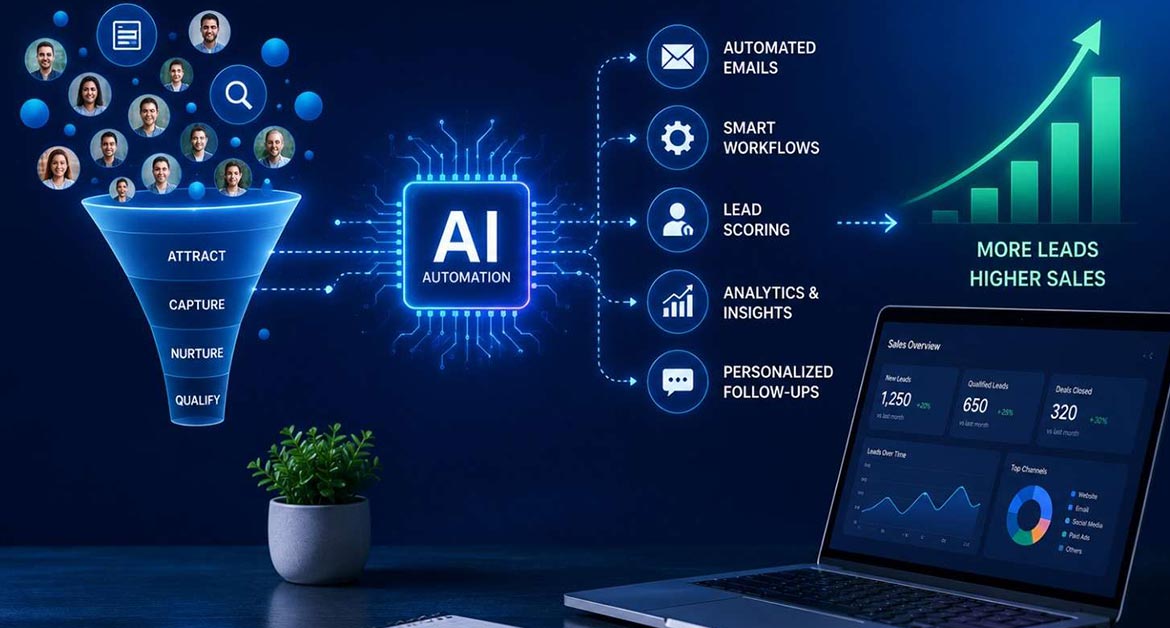
AI-powered CRM systems combine Customer Relationship Management software with Artificial Intelligence technologies to create smarter, faster, and more efficient sales operations.
Traditional CRM systems help businesses organize customer information, communication history, sales pipelines, and operational reporting. However, AI-powered CRM systems go much further by analyzing operational data, automating workflows, predicting customer behavior, and improving operational decision-making.
Artificial Intelligence allows CRM systems to continuously learn from customer interactions and operational activities. The more data these systems process, the more intelligent and accurate they become.
Predictive Intelligence
AI analyzes operational data and predicts future sales opportunities and customer behavior.
Automation
Automated workflows reduce repetitive tasks and improve operational efficiency.
Real-Time Visibility
Businesses gain instant access to customer activity, pipeline performance, and sales insights.
Why Traditional Sales Operations Struggle
Many businesses still rely heavily on spreadsheets, manual reporting, disconnected communication systems, and outdated administrative workflows.
These traditional methods create several operational challenges:
- Slow decision-making
- Inaccurate forecasting
- Missed customer follow-ups
- Human data entry errors
- Poor operational visibility
- Limited sales coordination
- Administrative overload
Sales representatives often spend too much time updating records, organizing reports, and managing repetitive tasks instead of focusing on customer engagement and revenue generation.
As pipelines grow larger and customer expectations increase, traditional sales operations become difficult to manage efficiently.
AI Improves Lead Management
Lead management is one of the most important aspects of sales operations.
Without proper lead prioritization, businesses waste valuable time pursuing low-quality opportunities while missing more valuable prospects.
AI-powered CRM systems improve lead management through:
- Intelligent lead scoring
- Customer behavior analysis
- Opportunity prioritization
- Predictive conversion analysis
AI systems analyze customer engagement, website behavior, purchase history, communication patterns, and interaction activity to identify which leads are most likely to convert.
This helps sales teams focus on high-value opportunities while improving operational efficiency and conversion rates.
Workflow Automation Improves Efficiency
Sales representatives often spend large amounts of time performing repetitive administrative tasks such as:
- Updating customer records
- Scheduling follow-ups
- Managing emails
- Preparing reports
- Tracking pipeline activity
AI-powered CRM systems automate many of these workflows automatically.
Automation helps businesses:
- Schedule follow-ups instantly
- Generate reminders automatically
- Assign leads intelligently
- Track customer activity in real time
- Update customer records continuously
This significantly reduces administrative workload and improves operational consistency.
Sales teams can spend more time building relationships, improving customer engagement, and closing deals.
Real-Time Sales Insights
Modern sales operations require real-time visibility into operational performance.
AI-powered CRM systems provide instant access to:
- Pipeline activity
- Revenue performance
- Customer engagement
- Sales productivity
- Forecasting data
- Operational bottlenecks
Managers can quickly identify delays, inactive opportunities, pipeline weaknesses, and operational inefficiencies before they negatively impact revenue growth.
This improves decision-making speed and operational responsiveness.
Predictive Sales Forecasting
Forecasting plays a critical role in business planning and growth strategies.
Traditional forecasting methods often rely on manual assumptions, outdated reports, and historical spreadsheets that may no longer reflect current operational conditions.
AI-powered CRM systems improve forecasting by analyzing:
- Customer behavior
- Pipeline activity
- Sales trends
- Revenue history
- Conversion rates
- Market activity
These systems continuously update forecasting models as operational conditions change.
Businesses gain more accurate revenue projections and stronger operational planning capabilities.
Personalized Customer Experiences
Modern customers expect businesses to understand their preferences, communication habits, and operational needs.
AI-powered CRM systems analyze customer behavior and generate personalized recommendations for:
- Communication strategies
- Product recommendations
- Follow-up timing
- Customer engagement
This helps businesses create more relevant and personalized customer experiences.
Personalization improves:
- Customer satisfaction
- Customer loyalty
- Conversion rates
- Long-term retention
Faster Customer Communication
Customers expect businesses to respond quickly to inquiries and requests.
Slow communication often results in lost opportunities and lower customer satisfaction.
AI-powered CRM systems improve communication speed through:
- Automated responses
- AI chat systems
- Workflow automation
- Intelligent routing systems
Leads can be directed instantly to the correct sales representatives while customers receive faster and more organized support experiences.
Improving Team Productivity
AI systems improve sales productivity by helping teams:
- Prioritize opportunities
- Reduce repetitive tasks
- Organize workflows
- Track operational activity
- Improve follow-up consistency
Higher productivity allows businesses to manage more customers, improve conversion rates, and generate stronger revenue growth.
Reducing Human Errors
Manual sales operations often create:
- Incorrect data entry
- Duplicate customer records
- Missed follow-ups
- Reporting inconsistencies
AI-powered CRM systems reduce these risks through automation, centralized reporting, intelligent validation systems, and real-time synchronization.
This improves operational accuracy and reduces costly operational mistakes.
Improving Customer Retention
Customer retention is essential for long-term business success.
AI-powered CRM systems help businesses monitor customer engagement and identify signs of dissatisfaction before customers leave.
AI systems can:
- Track customer activity
- Analyze communication patterns
- Predict churn risks
- Recommend retention strategies
This proactive approach strengthens customer relationships and improves long-term loyalty.
Better Collaboration Across Departments
Sales operations often involve collaboration between:
- Sales teams
- Marketing departments
- Customer support
- Finance teams
- Operations managers
AI-powered CRM systems improve collaboration by centralizing operational information and creating shared visibility across departments.
Teams can coordinate workflows more effectively while improving communication and operational efficiency.
Real-Time Operational Visibility
Operational visibility is essential for managing modern sales environments.
AI-powered CRM systems provide managers with real-time access to:
- Sales performance
- Pipeline movement
- Customer engagement
- Forecasting data
- Operational productivity
This visibility improves operational control and helps organizations respond quickly to changing business conditions.
Financial Benefits of AI-Powered CRM Systems
Increased Revenue
AI-powered CRM systems improve conversion rates and sales performance through smarter lead management and customer engagement.
Lower Operational Costs
Workflow automation reduces administrative work and operational inefficiencies.
Improved Productivity
Sales representatives can focus more on revenue-generating activities instead of repetitive administrative tasks.
Better Forecasting Accuracy
Businesses make more informed financial and operational decisions.
Improved Profitability
Efficient operations contribute directly to stronger long-term profitability.
Real-World Example
A growing company struggled with disorganized lead management, delayed follow-ups, poor forecasting, and inefficient operational coordination.
Sales representatives spent too much time updating spreadsheets and manually managing customer information.
After implementing an AI-powered CRM system:
- Lead prioritization improved significantly
- Follow-up automation increased consistency
- Forecasting became more accurate
- Sales productivity improved
- Customer engagement strengthened
- Revenue growth increased
The company achieved stronger operational organization and more scalable sales performance.
Challenges in Implementing AI CRM Systems
Initial Technology Investment
AI-powered CRM systems require upfront implementation costs.
Employee Resistance to Change
Some employees may initially hesitate to adopt AI-driven operational systems.
Data Quality Requirements
AI systems require organized and accurate customer data to function effectively.
Training Requirements
Employees need proper training to use AI-powered CRM platforms successfully.
Best Practices for AI CRM Success
Businesses can improve implementation success by:
- Centralizing operational data
- Maintaining accurate customer records
- Automating repetitive workflows
- Training employees properly
- Monitoring system performance continuously
These strategies improve long-term operational performance and AI adoption success.
The Future of AI in Sales Operations
AI technologies will continue evolving through:
- Advanced predictive analytics
- Smarter automation systems
- AI-powered forecasting
- Intelligent customer engagement
- Real-time operational intelligence
Future CRM systems will become even more proactive, autonomous, and data-driven.
Businesses that modernize sales operations early will gain stronger competitive advantages in the future.
Conclusion
AI-powered CRM systems are transforming modern sales operations by improving visibility, automation, forecasting, and customer engagement.
Traditional sales management methods based on spreadsheets and manual processes can no longer support the speed and complexity of modern business environments.
AI-driven CRM platforms help businesses automate repetitive tasks, prioritize leads intelligently, analyze customer behavior, and improve operational decision-making in real time.
By improving productivity, reducing operational delays, strengthening customer relationships, and increasing forecasting accuracy, AI-powered CRM systems create smarter and more scalable business operations.
One of the greatest advantages of Artificial Intelligence is its ability to continuously analyze operational data and transform information into actionable insights that improve business performance over time.
As customer expectations continue rising and competition becomes increasingly data-driven, businesses that fail to modernize sales operations may struggle to maintain operational efficiency and long-term growth.
Ultimately, AI-powered CRM systems are not simply software platforms — they are intelligent operational tools that help organizations build faster, smarter, and more efficient sales environments prepared for future business success.